When we gathered 30 investors together during our first ever VC Unlocked program focused exclusively on AI and really dove in, a sharper, more contrarian set of ideas surfaced.
2026.06.25

Carlos Ruiz del Vizo
The AI investing conversation has gotten loud, and also somewhat repetitive. Data moats. Don't over-index on the model. Stay disciplined. Sure.
When we gathered 30 investors together during our first ever VC Unlocked program focused exclusively on AI and really dove in, a sharper, more contrarian set of ideas surfaced.
Here are five insights from VC Unlocked: AI Edition that investors can apply:
1. The consulting giants are racing to cannibalize themselves. You should be asking why.
As Jake Saper of Emergence Capital explained, most AI companies are still selling the “fishing pole,” i.e. a tool, a platform, a seat. But the most exciting AI businesses are already selling the “fish,” thereby guaranteeing the outcome.
McKinsey, Accenture, and Deloitte are investing in their own AI consulting practices. Not necessarily because they're excited about AI, but because they understand that if they don’t, AI-native services companies will eat them alive. And they’d rather cannibalize themselves first. When incumbents hedge against their own extinction, that's a signal.
Competing in this space means that now you’re going after the services economy, which is a market 10–20x larger than the software market. If this sounds more appealing to you than fighting the crowded and rapidly commoditizing AI apps and model API space, consider taking a closer look into this area!
Signal to look for: Does the startup you’re looking at price on output delivered or access granted? Is there an incumbent services player whose lunch they're eating?
2. The human you'd cut is the moat.
For many VCs these days, the instinct is to reward companies that remove humans from the equation. What kept surfacing at VC Unlocked: AI Edition was the opposite: in regulated industries and high-stakes workflows, the human on top isn't overhead; it's why the customer trusts the startup with their data.
Enterprises want someone who will be accountable if something goes wrong. As intelligence commoditizes, that credentialed domain expert becomes the scarce resource.
During the program, the "revenge of the business people" framing resonated with many: deep domain expertise is more valuable than technical fluency for the first time in a decade.
Founder filter: Have the founders spent years inside the problem? Would the customer have trusted them before the AI existed?
3. Most AI companies are quietly failing the basic test of being a good business.
Healthy SaaS companies run 75–85% gross margins. Most AI-native companies are sitting at 50–70%, and are being dragged down by inference costs, human-in-the-loop labor, and API fees that scale with usage. That gap is a path-to-profitability problem.
One of the questions that divided the room was: is speed or profit more important? The real answer is neither. It's the credible path. Hypergrowth at deeply negative margins is getting punished. But over-optimizing margins too early means getting outpaced. The startups currently winning have a specific, time-bound plan: model routing to cheaper inference, caching repeated outputs, and shifting to fine-tuned open-source models as volume scales.
The sharpest metric isn't cost per API, it's cost per successful outcome, including human cleanup when the AI fails. That's the number that tells you whether unit economics actually work.
Diligence question: What are gross margins today, and what's the operational path to 65%+?
4. Write down how you'll know you're wrong — before you wire the money.
It’s often said that the venture business rewards being both contrarian and right. But "contrarian" without a way to be proven wrong is just stubbornness.
The most useful framework of the week was: before committing to a thesis, write down exactly what you'd need to see to know you're wrong. Not what would make you nervous…but what would definitively prove that you are wrong. This changes how you hold conviction. When the signal you pre-identified comes, you recognize it instead of rationalizing it away.
In a market where "70x ARR looks cheap," the ability to walk away from a great story is the rarest skill in the room.
The exercise: Complete this sentence for your top AI investment: "I will know I'm wrong if ___." If you can't, you don't have a thesis — you have a hope.
5. A model isn't a strategy. It's a dependency with a two-week shelf life.
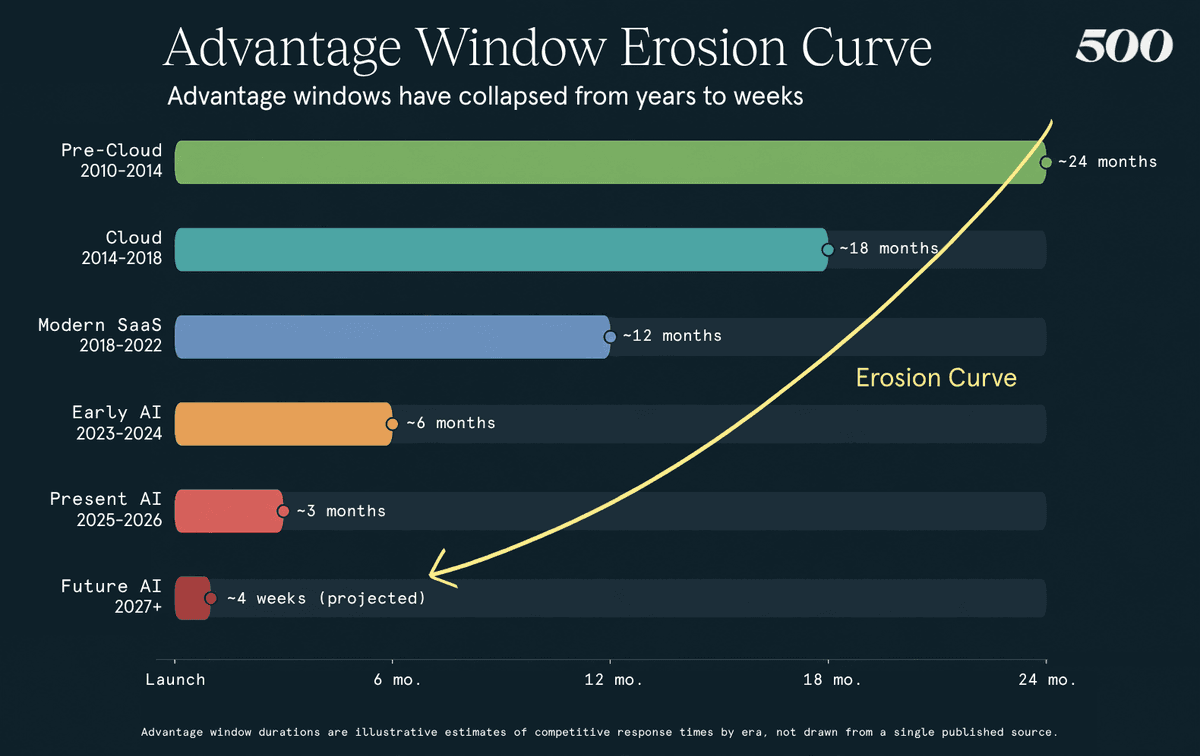
If a company's core insight is that they “use Frontier Model X”, that insight has roughly two weeks of shelf life.
The operators thinking clearly about model strategy aren't betting on a single provider, they're routing tasks to the right model at the right cost. Plan with one, execute with a cheaper one, fall back to open source at scale. A 30-60%+ reduction in inference costs is available today with basic model routing.
The longer bet: open-source models are closing the gap with frontier labs faster than most expect. Going "very long on the open-source ecosystem" is increasingly a practical hedge, not a philosophical stance.
Question to ask founders: Is your model selection a business choice or a technical dependency — and what's your plan when it gets undercut?
—
These five ideas kept surfacing across sessions, case studies, and debates throughout the 4 day VC Unlocked AI Edition program, which was held in San Francisco in early June 2026. Investors from around the world spent time pressure-testing their AI theses and building sharper diligence frameworks for investing in AI startups.
For other upcoming venture education programs, visit 500.co/venture-education.