2026.04.02

Demola Adegbite
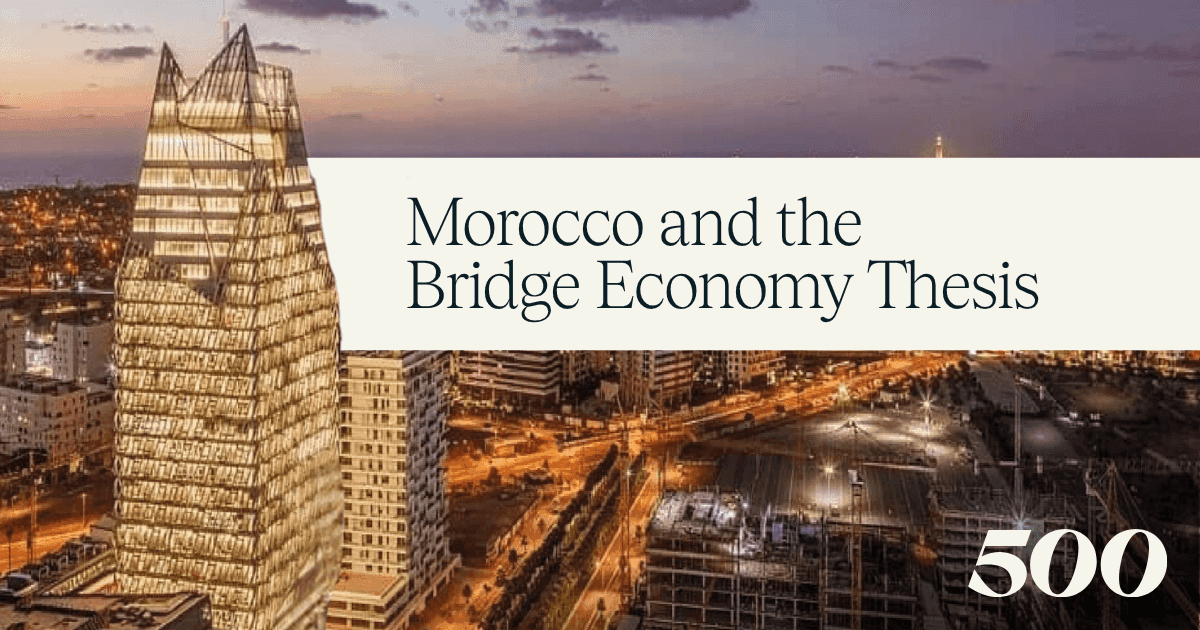
At 500 Global, we have spent over fifteen years building in emerging tech ecosystems, focusing on markets where entrepreneurship is not only growing, but solving real economic and structural challenges. We’ve followed this playbook in Southeast Asia, Latin America, across the Middle East and now Africa. In each case, the signals we’ve observed have been the same: a convergence of policy momentum, rising founder quality, and a consumer base ready to skip legacy infrastructure entirely.
Today, we see that same convergence in Morocco.
 Sources: 2024 Morocco Startup Ecosystem Report; UNCTAD World Investment Report 2025
Africa’s Bridge Economy
Morocco sits at a genuinely rare intersection: it borders Europe, anchors North Africa, and maintains deep commercial ties across the Middle East, Sub-Saharan Africa, and beyond. It is an African Union member, a signatory of the African Continental Free Trade Area (AfCFTA), and holds advanced partnership status with the EU. We believe no other African market offers that combination of connectivity.
For founders, this is not a footnote. It can be a structural advantage. Building in Morocco means building with natural distribution corridors into Europe, Francophone Africa, and the Gulf. It means access to a multilingual talent pool, and it means operating in a jurisdiction that we see as increasingly investor-friendly and globally legible.
We see Morocco as Africa’s bridge economy: it is not just a local market. We see it is a launchpad.
Six Signals of Market Readiness
At 500 Global, we assess market readiness through our Eco6 framework—a six-part model that evaluates the core building blocks of a startup ecosystem: policy, pipeline, adoption, talent, capital, and support infrastructure. When we applied this framework to Morocco, the picture was clear.
- Government policy. Morocco’s Digital Morocco 2030 strategy sets a formal roadmap: $140 million in public investment, a target of 3,000 startups by 2030, and a dedicated Startup Label giving officially recognized startups access to streamlined regulation and procurement. Alongside this, the Programme Startup Maroc and the Mohammed VI Investment Fund (FM6I) are providing institutional backbone to the ecosystem. The FM6I, the Ministry of Digital Transition and Administrative Reform, and the Caisse de Dépôt et de Gestion (CDG) launched the Startup Funds initiative in 2024, attracting 47 fund manager applications, of which 33 came from international VC firms, a signal of external conviction in Morocco’s direction.
- Startup pipeline. Moroccan founders are building globally from day one. Nuitee, a hotel connectivity platform, raised a record $48 million Series A in 2024, Morocco’s largest-ever venture round. Spore.Bio, co-founded by Moroccan entrepreneur Amine Raji, raised a $23 million Series A in February 2025, led by Singular and Point72 Ventures, to scale its AI-powered microbiology testing platform that cuts pathogen detection time from days to minutes. In January 2026, Spore.Bio became one of 12 startups globally selected by the Google.org AI for Science Fund, securing additional multi-million dollar philanthropic investment and launching Spore.Labs, a dedicated AI-native research unit. According to the 2024 Morocco Startup Ecosystem Report, Moroccan startups raised $94.96 million across 40 deals in 2024, up from $26 million in 2022, a near four-fold increase in two years. Fintech led deal count at 27.5% of transactions, followed by logistics and mobility at 17.5%.
- Technology adoption. Morocco’s mobile penetration exceeds 149% and national internet penetration exceeds 90%. Online card payments grew 20% in 2024 to 38.5 million transactions, according to Bank Al-Maghrib's annual payment systems report. Digital banking adoption is accelerating, with mobile transactions growing double-digits year-over-year. Behavioral shifts triggered by the COVID-19 period are not reversing: they seem to be expanding into B2B software, logistics, and healthtech.
- Talent pool. Morocco produces more than 11,000 engineering graduates annually, many from institutions with competitive international rankings. Morocco's educated workforce is predominantly bilingual in Arabic and French, with English proficiency growing rapidly among younger tech graduates, which can be a meaningful advantage for founders targeting European and African markets.
- Venture capital availability. Morocco ranked 6th in Africa in 2024 by VC funding, with $94 million in equity investment according to the 2024 Morocco Startup Ecosystem Report. As recently as 2018, Morocco attracted just $3 million in total VC. The turning point seemed to be the first edition of the Innov Invest Fund, a Tamwilcom (ex “CCG”) initiative co-financed by the World Bank, which catalysed the launch of new institutional vehicles as well as the launch of key local funds including Al Mada Ventures, UM6P Ventures, and 212 Founders (CDG Invest). The $150 million Startup Fund of Fund attracted significant international interest.
- Startup support ecosystem. In December 2025, the Ministry of Digital Transition and Administrative Reform officially launched the Startup Venture Building (Startup VB) program, a significant government-backed startup initiative. Coordinated with Tamwilcom and backed by a $75 million envelope, Startup VB aims to support more than 800 startups over three years through a continuum of four financial instruments: from early ideation grants to seed loans of up to $200,000. Six operators were selected to run the program nationally, including 500 Global as one of four international partners alongside Flat6Labs, Renew Capital, and Open Startup International. For founders, Startup VB represents direct, structured access to capital and a network of global mentors, from day one.
From Aid to Commercial Momentum
One of the most important signals from any emerging market is the transition from aid-dependent models to commercially self-sustaining ones. Morocco appears to be further along this curve than many African markets based on the numbers.
Foreign direct investment surged 55% in 2024 to $1.64 billion, according to UNCTAD’s World Investment Report 2025, making Morocco the leading driver of FDI growth across North Africa. Total FDI stock reached $61.5 billion by year-end. These are not portfolio flows or one-off grants: they reflect long-term bets by global industrial players on Morocco’s structural position.
One clear signal came from Safran, the French aerospace group that has operated in Morocco for 26 years with over 4,800 employees across 10 sites. In 2024 and 2025, Safran committed over €350 million to Morocco, including Africa’s first aircraft engine assembly plant for the Airbus A320neo near Casablanca, a new Maintenance, Repair, and Overhaul facility, and a €280 million landing gear manufacturing plant announced in February 2026. By 2030, Safran alone will have created more than 2,000 new jobs in Morocco.
This industrial commitment matters for tech founders for two reasons. First, it demonstrates that these global multinationals seem to have already absorbed the due diligence risk of operating in Morocco, helping to validate the regulatory and logistical environment. Second, it creates a growing class of professional, technically literate workers and enterprise clients who are likely natural early adopters of digital solutions in procurement, HR, logistics, and financial services.
We believe Morocco’s most compelling startups are solving real structural problems: access to credit, agricultural productivity, cross-border trade, healthcare delivery. But they are doing so with scalable, commercial business models designed to grow without subsidy. That combination, real problems, proven market, commercial architecture, is where we believe compelling early-stage returns can be generated.
When we mapped our market readiness framework across Africa, Morocco stood out clearly as an opportunity. Morocco combines strong macro momentum, a sizable population, a growing pool of tech talent, and supportive government initiatives. At the same time, digital adoption across sectors is catching up, creating an exciting opportunity for founders to build market-fit tech solutions that have the potential to scale regionally and globally.
Morocco's Builders Are Ready. So Are We.
Moroccan founders building scalable, regionally ambitious, commercially viable companies have our attention. Based on our observations, the signals we look for when entering a new market: policy momentum, founder quality, and commercial adoption are converging in Morocco right now, and we believe the ecosystem is approaching a genuine inflection point.
We've made this call before. We're making it again here.
If you're a founder, investor, or operator who shares our conviction in Morocco's potential, we'd love to stay connected. Sign up below to be among the first to hear what we're building in the region.
Join the waitlist →